Posts

THE BACKWARDNESS OF ELECTRIC TRACTION IN GREAT BRITAIN

Popular objections to the overhead system are not, of course, quite dead. Every tramway proposal in districts where the trolley has not already penetrated is still opposed on the ground of disfigurement and danger. This opposition serves as an index to the severity of the struggle which the advocates of the trolley system had to encounter before they made it almost universal in large cities. But the dislike of the public for a questionable novelty was not the sole reason why electric tramway enterprise was backward in Great Britain. It is not strictly accurate to say that electric tramway enterprise was backward. The enterprise was there, in spirit, but circumstances were very much against it. Tramway schemes are controlled by special legislation which was passed before electric traction was contemplated; and this legislation has not been amended in any material degree to suit the altered conditions brought about by the use of electricity. The Tramways Act, 1870—which is...

CONDUIT AND SURFACE-CONTACT TRAMWAY SYSTEMS

Image
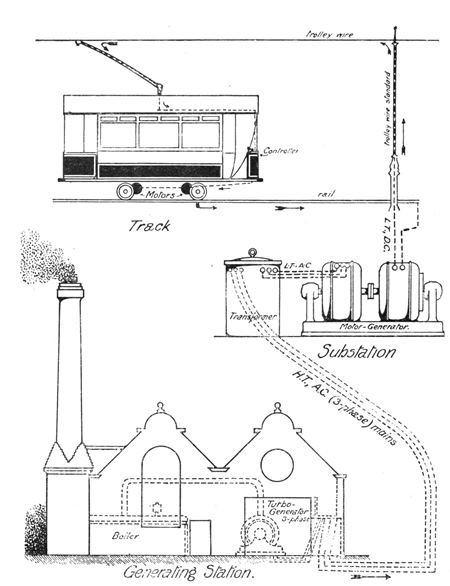
Roughly speaking, the arrangements for generating electricity, distributing it, and utilising it on the car, remain the same in conduit tramways and surface-contact tramways as on the overhead system. The differences between the three systems are, as already indicated, confined to the means of collecting the current for each car. Both the conduit and the surface-contact system were suggested as a means of escape from the main objection to the overhead system—the exposure of 'live' wires in the street. The cable tramway, with its concrete trough and slot, gave an obvious hint. There would be no difficulty, apparently, in carrying wires on insulators in the trough or conduit, and utilising the slot for a 'plough' which would slide along inside the conduit, keeping contact with the wires, and so conveying the current to the car. This was tried for the first time in Blackpool, where—in 1884—a length of conduit tramway was laid along the front street of the t...

THE MECHANISM OF AN ELECTRIC TRAMCAR: THE OVERHEAD SYSTEM

Image
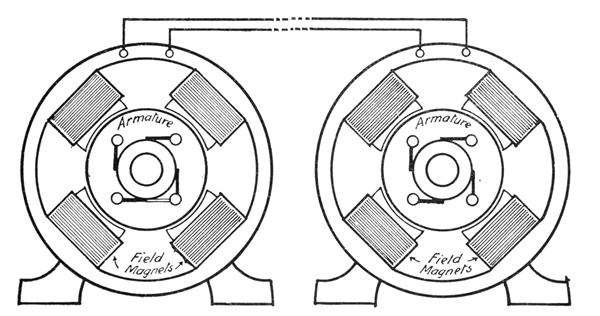
A rough idea has already been given of the elementary mechanism of electric traction—the combination of generating station, of cars fitted with electric motors, and of a sliding contact between the two. It is in connection with the sliding contact that the ingenuity of tramway engineers has been mainly exercised. Three distinct solutions were evolved for tramway work, giving rise to three systems—(1) the overhead or trolley system; (2) the conduit system; and (3) the surface-contact system. The first system is now almost universal in the United Kingdom. Part of the London system is equipped on the conduit system; and the tramways at Lincoln and Wolverhampton are constructed on the surface-contact system. Beyond these cases the trolley holds the field. In the United States and on the Continent there is a larger proportion of conduit work, but from a practical point of view it would hardly be necessary to mention either conduit or surface-contact if it were not for the gr...

THE ESSENTIAL ADVANTAGES OF ELECTRIC TRACTION ON TRAMWAYS

Image
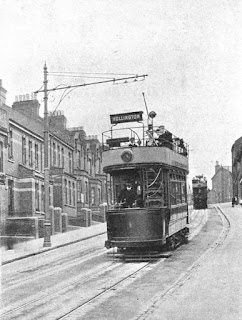
A railway journal once committed itself to the statement that horse traction was superior to electric traction on roads because the horse possessed the 'vital principle' of energy in its constitution. It is distinctly curious to find an authority on locomotion describing the essential drawback of horse traction as its distinguishing advantage. The 'vital principle,' unfortunately, needs food and rest to maintain it not only during working hours but during the hours of inactivity as well. In actual practice four horses out of every five in a tramway stud are in the stables while the fifth is at work. Moreover, the same stud has to be kept up, at a practically uniform cost, whether the daily traffic be light or heavy. Thirdly, the 'vital principle' has only a limited number of years during which—apart from sickness and disease—it is effective for traction purposes. Fig. 2. A typical electric tramway on the overhead system.—The trolley stan...

THE BIRTH OF ELECTRIC TRACTION

Image
The story of electric traction really begins in the laboratory of Faraday. He was the first to produce mechanical rotation by electrical means; and, although he had no practical end in view, his investigations produced the germ of the commercial dynamo and thence of the commercial electric motor. That germ, however, took about half a century to develop. It is true that in 1837 (about ten years after Faraday's discovery) Robert Davidson experimented with an electric locomotive on the Edinburgh and Glasgow Railway; it is also true that Jacobi, two years later, propelled a boat on the Neva with electric power. But these early attempts were not on a commercial scale. Not only was the motor a crude contrivance, but the method of producing the electric power was hopelessly extravagant. At that period the 'primary battery'—similar in character to those still used for laboratory purposes, ringing electric bells, and so on—was the best available source of electricit...

EARLY TRAMROADS AND RAILWAYS

It has sometimes been remarked, by unfriendly critics, that tramways are an apology for bad roads. That is to say, if road surfaces were perfect, there would be no need to lay rails in order to allow vehicles to run easily. Although this view of the case may be no better than a quarter-truth, it is justified to the extent that tramways were, as a matter of fact, the outcome of an attempt to escape from bad road surfaces. In the early days of mining, coals were taken by horsedrawn wagons from the pits to the harbours. The passage and re-passage of heavy vehicles on the same roadway led to the formation of deep ruts; and the first step towards both the tramway and the railway was taken when logs of wood or 'trams' were laid in the ruts to facilitate transport. The next step was to make the upper surface of the log round and the rims of the wheels hollow, so that they fitted over the rails and kept the wagonson the track. Owing to the upper part of the rails wearing away quickl...

SUMMARY OF MECHANICAL PROGRESS

THE REAL beginning of the present age of machinery dates from Watt’s invention of the double-acting steam engine which was patented in 1782. Prior to that date the steam engine was used merely for pumping water, but now in its new form it was adapted for use in driving industrial machinery. But, as we have shown in another chapter, it was not until John Wilkinson invented his boring machine in 1774 that it was possible to bore the cylinders that Watt used in his engine. In the field of machine tools there were several notable inventions. Henry Maudslay invented the slide rest for lathes and later in 1797 the screwcutting lathe. Joseph Bramah invented the hydraulic press and Maudslay furnished the cup leather packing that made it a success. Woodworking machinery, and particularly mortising machines for making pulley blocks, were invented by Samuel Bentham and patented in 1791 and 1793. In the textile industry we find the spinning jenny invented by Hargreaves in 17...