Posts

REGENERATIVE CONTROL

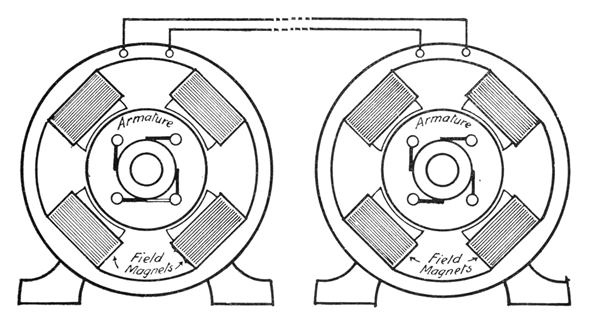
Before going on to discuss the 'accumulator' or 'storage battery' system of electric traction, reference should be made to an invention which holds the germ of great economies in electric traction. This invention is known under the name of 'regenerative control.' It has already been explained that the dynamo is reversible—that is to say, a dynamo may act as a motor, or a motor as a dynamo. This fact is usefully applied in braking tramcars. When a car has gained speed, its momentum represents a certain amount of stored energy. In stopping the car, this energy has to be absorbed or dissipated in some way or other. One method is to utilise the friction of brake blocks on the wheels, or of skids on the rails themselves. With the electric car, however, it is possible to absorb the energy by making it drive the motors as if they were dynamos. The moving car drives the wheels, which in turn drive the motors; and the current so generated may either be abs...

ELECTRIC TRAMWAY STAGNATION. THE TROLLEY OMNIBUS

Image
The revenue of a tramway is built up of pennies; and a minute increase in the average earnings per passenger will therefore have a large effect on the total receipts. For instance, it was calculated (in 1907) that an increase of one-tenth of a penny in the average fare on the sixty systems under the control of the British Electric Traction Company would mean an increase of over £200,000 in the revenue. Similarly, a fractional decrease in one of the operating expenses—say, the cost of electric current—might transform a shaky undertaking into a sound one. Tramway finance, in fact, is a question of infinitesimals. So long as fares are determined by arbitrary conditions, little can be done to increase the revenue on an electric tramway system. Such matters as the weather and the extent of building operations have far more influence on tramway traffic than anything the tramway manager can do to assist it. Apart from the development of parcels traffic, his best opportunities l...

THE BACKWARDNESS OF ELECTRIC TRACTION IN GREAT BRITAIN

Popular objections to the overhead system are not, of course, quite dead. Every tramway proposal in districts where the trolley has not already penetrated is still opposed on the ground of disfigurement and danger. This opposition serves as an index to the severity of the struggle which the advocates of the trolley system had to encounter before they made it almost universal in large cities. But the dislike of the public for a questionable novelty was not the sole reason why electric tramway enterprise was backward in Great Britain. It is not strictly accurate to say that electric tramway enterprise was backward. The enterprise was there, in spirit, but circumstances were very much against it. Tramway schemes are controlled by special legislation which was passed before electric traction was contemplated; and this legislation has not been amended in any material degree to suit the altered conditions brought about by the use of electricity. The Tramways Act, 1870—which is...

CONDUIT AND SURFACE-CONTACT TRAMWAY SYSTEMS

Image
Roughly speaking, the arrangements for generating electricity, distributing it, and utilising it on the car, remain the same in conduit tramways and surface-contact tramways as on the overhead system. The differences between the three systems are, as already indicated, confined to the means of collecting the current for each car. Both the conduit and the surface-contact system were suggested as a means of escape from the main objection to the overhead system—the exposure of 'live' wires in the street. The cable tramway, with its concrete trough and slot, gave an obvious hint. There would be no difficulty, apparently, in carrying wires on insulators in the trough or conduit, and utilising the slot for a 'plough' which would slide along inside the conduit, keeping contact with the wires, and so conveying the current to the car. This was tried for the first time in Blackpool, where—in 1884—a length of conduit tramway was laid along the front street of the t...

THE MECHANISM OF AN ELECTRIC TRAMCAR: THE OVERHEAD SYSTEM

Image
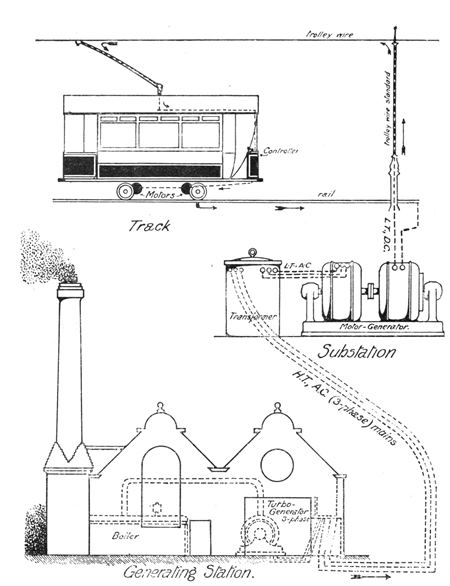
A rough idea has already been given of the elementary mechanism of electric traction—the combination of generating station, of cars fitted with electric motors, and of a sliding contact between the two. It is in connection with the sliding contact that the ingenuity of tramway engineers has been mainly exercised. Three distinct solutions were evolved for tramway work, giving rise to three systems—(1) the overhead or trolley system; (2) the conduit system; and (3) the surface-contact system. The first system is now almost universal in the United Kingdom. Part of the London system is equipped on the conduit system; and the tramways at Lincoln and Wolverhampton are constructed on the surface-contact system. Beyond these cases the trolley holds the field. In the United States and on the Continent there is a larger proportion of conduit work, but from a practical point of view it would hardly be necessary to mention either conduit or surface-contact if it were not for the gr...

THE ESSENTIAL ADVANTAGES OF ELECTRIC TRACTION ON TRAMWAYS

Image
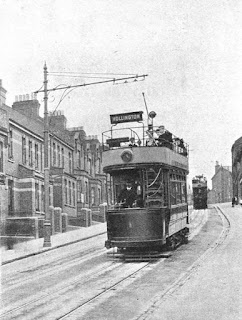
A railway journal once committed itself to the statement that horse traction was superior to electric traction on roads because the horse possessed the 'vital principle' of energy in its constitution. It is distinctly curious to find an authority on locomotion describing the essential drawback of horse traction as its distinguishing advantage. The 'vital principle,' unfortunately, needs food and rest to maintain it not only during working hours but during the hours of inactivity as well. In actual practice four horses out of every five in a tramway stud are in the stables while the fifth is at work. Moreover, the same stud has to be kept up, at a practically uniform cost, whether the daily traffic be light or heavy. Thirdly, the 'vital principle' has only a limited number of years during which—apart from sickness and disease—it is effective for traction purposes. Fig. 2. A typical electric tramway on the overhead system.—The trolley stan...

THE BIRTH OF ELECTRIC TRACTION

Image
The story of electric traction really begins in the laboratory of Faraday. He was the first to produce mechanical rotation by electrical means; and, although he had no practical end in view, his investigations produced the germ of the commercial dynamo and thence of the commercial electric motor. That germ, however, took about half a century to develop. It is true that in 1837 (about ten years after Faraday's discovery) Robert Davidson experimented with an electric locomotive on the Edinburgh and Glasgow Railway; it is also true that Jacobi, two years later, propelled a boat on the Neva with electric power. But these early attempts were not on a commercial scale. Not only was the motor a crude contrivance, but the method of producing the electric power was hopelessly extravagant. At that period the 'primary battery'—similar in character to those still used for laboratory purposes, ringing electric bells, and so on—was the best available source of electricit...